
News - September 1, 2026 - by RachelDahl
Nevada's long-running argument over election integrity has largely been fought in political terms, but Secretary of State Cisco Aguilar would rather talk about flash drives and the little details that build public trust in a process integral to our very system.
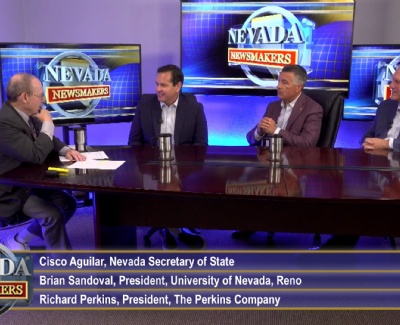
During a two-part Nevada Newsmakers discussion on election security, Aguilar laid out a series of less visible changes made to Nevada's election system since 2022 — new statewide voter-registration technology, new voting equipment in all 17 counties, changes in how mail ballots are processed and a deliberate effort to shorten the time between Election Day and meaningful results.
The changes come as confidence in elections remains a political issue and Nevada, one of the nation's most closely watched swing states, prepares for another general election.
Aguilar said Nevada now ranks second in the nation for election administration in the Massachusetts Institute of Technology Election Performance Index, up from 13th following the 2020 election.
The independent index evaluates how states administer elections using measures including registration, voting, wait times, ballot processing and data transparency. Nevada's rise to No. 2 following the 2024 election has been independently reported by Nevada Public Radio.
"We have secure and safe elections," Aguilar told Nevada Newsmakers host Sam Shad, "not just from a cybersecurity [perspective], but also to know that the actual voter who is registered with the state of Nevada is the one casting the ballot and that those ballots are being counted in a fair and accurate way."
Aguilar appeared with former Nevada Gov. Brian Sandoval, now president of the University of Nevada, Reno, and former Assembly Speaker Richard Perkins. Sandoval and Perkins are involved with the Democracy Defense Foundation, a bipartisan effort organized in several battleground states to counter misinformation about elections and increase public confidence in election administration.
Much of their discussion dealt with the gap between how Nevada's election system actually operates and how voters perceive it.
One of the most significant changes is occurring inside the voting booth.
Aguilar said Nevada has moved statewide to ballot-marking devices, which may resemble the electronic voting machines voters have used in previous elections but function differently.
A voter makes selections electronically, but the machine produces a paper ballot. The voter can hold and review that ballot before personally placing it into a separate tabulator.
The change also reduced one of the less visible security problems associated with the previous system: managing large numbers of removable flash drives.
Under the former configuration, Aguilar said, a polling site with 50 voting machines could have 50 flash drives that election workers were required to account for and maintain through a secure chain of custody, but under the new system, only the tabulators require the drives.
"So now you go from 50 to three or four," Aguilar said.
That reduces the number of devices election officials must secure and also speeds the process of transferring results at election centers, he said.
The new equipment was first tested in three smaller Nevada counties during the 2024 election before being expanded to all 17 counties.
Nevada also implemented a statewide voter registration and election-management system that Aguilar said allows officials to identify potential problems across counties more quickly.
His office investigated approximately 84 election-related cases arising from the 2024 election, Aguilar said, with roughly eight referred to the Nevada Attorney General's Office for possible prosecution.
That distinction matters in a debate in which allegations of fraud and evidence of fraud are often treated as the same thing.
The panel did not argue that election violations never occur. Aguilar's position was that allegations can be investigated and individual violations identified without establishing widespread fraud capable of undermining an election.
The discussion became particularly relevant to rural Nevada when it turned to mail ballots.
About 60% of ballots cast in Nevada's June primary were cast by mail, according to state election data and independent analysis.
Aguilar said some of Nevada's highest rates of mail-ballot use occur not in Democratic urban precincts, but in rural and heavily Republican counties, a fact that complicates the increasingly partisan national debate over voting by mail.
A polling place that may be a few miles away in Las Vegas or Reno can be considerably farther from a voter in rural Nevada. Mail voting has consequently become a practical part of the election system for voters across the political spectrum.
Since 2022, Aguilar said, 86% of Nevada registered voters have used a mail ballot at least once.
The other persistent complaint surrounding Nevada elections is speed.
National television viewers have become accustomed to watching states turn red or blue on election night. Nevada has repeatedly taken longer to produce enough counted ballots for close races to be called.
Shad pressed Aguilar on why the state could not simply set deadlines that would allow results to be known by midnight on Election Day or early the following morning.
Aguilar's answer contained some of the most useful numbers in the two programs.
He said Nevada counties had approximately 98% of all ballots in their possession on election night in 2024. Fewer than 2% of mail ballots arrived afterward, and about 95% of those late-arriving ballots were received within 24 hours.
The larger problem, he said, is the enormous number of ballots delivered to polling places and drop boxes on Election Day itself.
Nevada law allows counties to begin processing mail ballots before Election Day. Aguilar said counties were essentially caught up with ballots received before then, only to receive another large batch on Election Day.
His office has been working with counties to change that process.
Previously, ballots deposited at polling locations could sit there until the end of the day before being transported to an election center. Counties have begun making multiple pickups during the day, allowing processing to start sooner.
Clark County, Aguilar said, processed every mail ballot from the recent primary within 24 hours after Election Day, but he acknowledged that Nevada still needs to get faster.
"I think Nevadans demand this," Aguilar said. "I want to figure out how we can do this, and I believe we can."
Clark and Washoe counties present the largest challenge simply because of scale. Aguilar compared Clark County to "a battleship trying to change," while describing Washoe County as large enough to test new systems but small enough to adjust more quickly.
A separate fight over mail voting is now playing out between states and the federal government. The U.S. Postal Service adopted new requirements this summer governing election mail, including ballot-envelope standards, barcodes and voter-information reporting. Nevada joined other states challenging those requirements, arguing that imposing them immediately before the November election would interfere with state administration of elections.
That case has moved rapidly through federal courts and on Sept. 4, a federal judge extended an injunction preventing the new requirements from taking effect for now. The Trump administration has again asked the U.S. Supreme Court to allow the Postal Service rules to proceed.
The legal dispute raises a larger constitutional question repeated throughout the Nevada Newsmakers discussion: how much authority the federal government has to influence an election system traditionally administered by states.
Sandoval, a former federal judge, emphasized that distinction. “Elections are the province of the states," he said.
The panel also looked considerably farther into the future, discussing the possibility of whether Americans could eventually vote by phone, Aguilar did not dismiss the idea.
He recently visited Estonia, where much of government operates digitally and voters can cast ballots electronically. But Aguilar said any comparable system in the United States would require cybersecurity capabilities and resources beyond what an individual state could reasonably provide.
Sandoval and Perkins also said some form of secure digital voting may eventually become inevitable as younger voters accustomed to conducting much of their lives on phones enter the electorate.
Sandoval said moving too quickly toward something like phone voting could worsen the very confidence problem election officials are trying to solve.
For now, Aguilar’s focus is much more basic: paper ballots voters can see, fewer devices to secure, faster processing and a system that can show people what happens to their vote. Which may be the larger point behind all the changes Nevada has made since 2022.
Public trust in elections is not built by telling voters to trust the system, it is built by making the system secure enough that they can see why they should.













| Home Page | Archived Shows | Weekly Schedule | Daily Quotes | Ray Hagar | Contact Nevada Newsmakers |
Podcast Help | Terms of Service | Privacy Policy | Advertise with Us |
© 2005-2026 Sam Shad Productions, All Rights Reserved.